In one line
Glimpse compares eight lightweight CLIP fusion heads, then trains a larger ViT–BERT co-attention model. The work separates architecture ideas from implementation mistakes by recording both results and the bugs found along the way.
Question
When an image encoder and a language encoder must answer a visual question together, which fusion design earns its complexity?
What I built
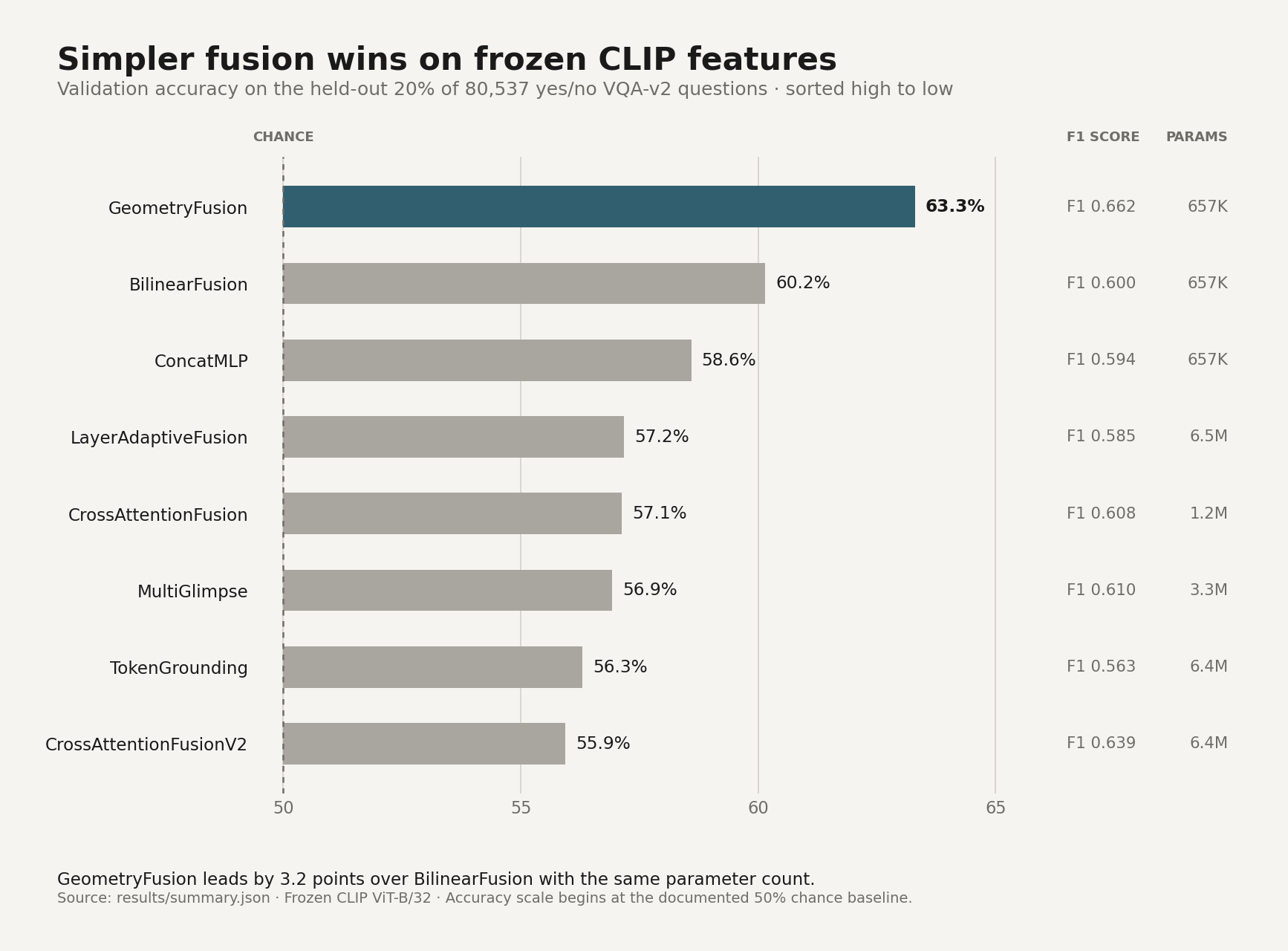
- Benchmarked eight fusion heads on frozen CLIP features so the comparison focused on how visual and text representations were combined.
- Built GeometryFusion, a 657K-parameter head that uses similarity structure instead of simply concatenating embeddings.
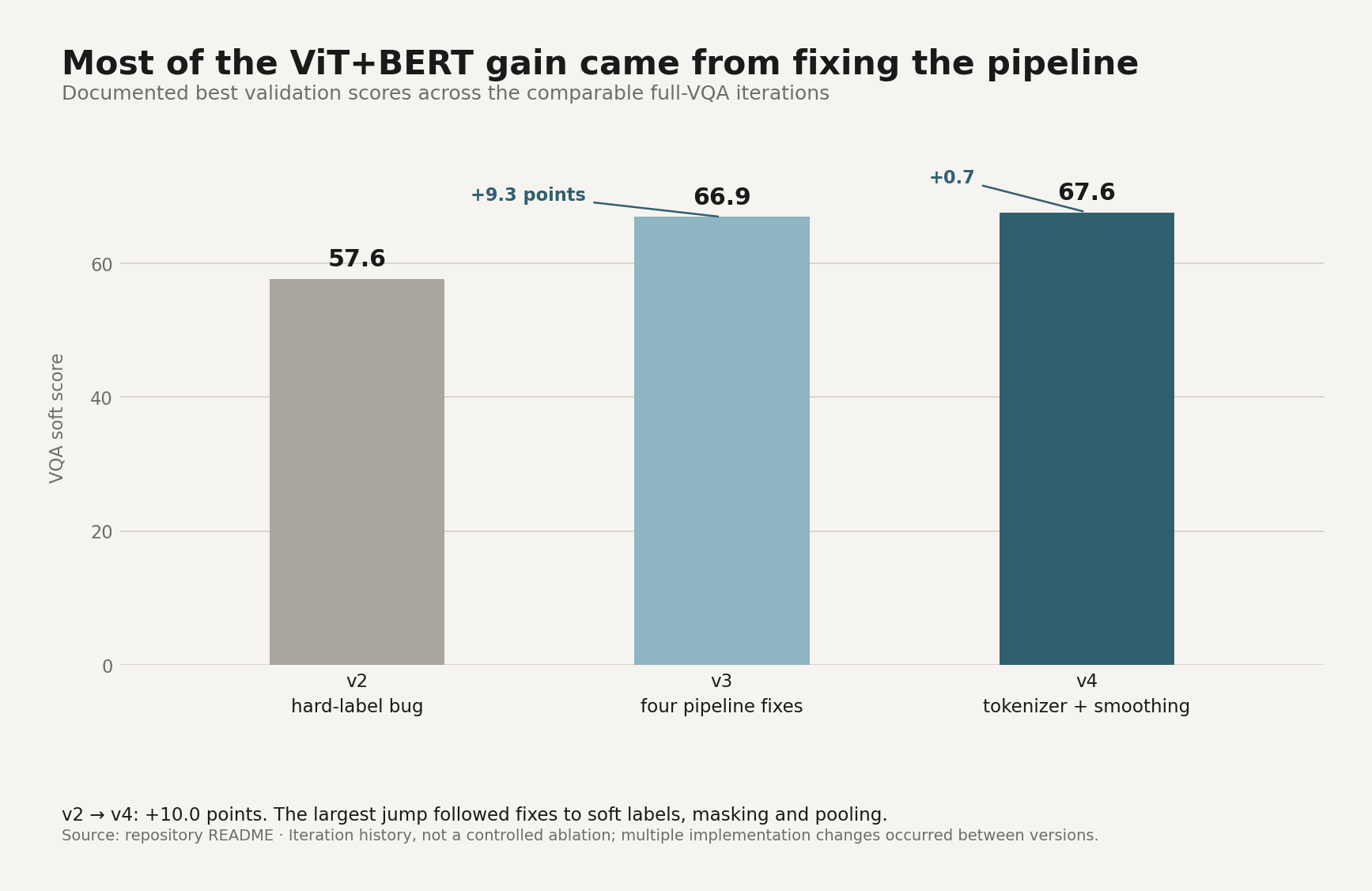
- Trained an end-to-end ViT-B/16 and BERT model with co-attention, while correcting soft-label, masking, pooling, and tokenization issues.
Main result
- best frozen-CLIP validation accuracy
- 63.3%
- VQA soft score for the ViT–BERT model
- 67.6
Result figures
What the work showed
- GeometryFusion led the frozen-feature track while staying small enough to train as a focused fusion experiment.
- The larger co-attention model improved the documented VQA soft score, but also made data and masking bugs much more consequential.
- Correct soft targets and attention masks changed the trustworthiness of the experiment as much as the architecture choice did.
What it does not prove
- The 63.3% accuracy and 67.6 soft score come from different documented experiment tracks and should not be compared as if they were the same metric.
- These are validation results from the recorded runs, not a claim of state-of-the-art performance.
Conclusion
The project showed that a thoughtful fusion head can beat simpler combinations without becoming large. It also reinforced a less glamorous result: clean labels and masks are prerequisites for believing any architecture comparison.