In one line
PaperScope compares a general evaluator with one calibrated on historical OpenReview evidence. The evaluation keeps paper text and labels separate, then measures whether calibration improves rating and decision estimates.
Question
Can an AI paper evaluator become more useful by learning a venue's historical standards without leaking the final review decision into its input?
What I built
- Created forum-level datasets from OpenReview while keeping model inputs closed and final decisions private during prediction.
- Used disjoint calibration and evaluation sets, plus hash checks, to reduce accidental leakage between examples.
- Measured rating error, decision accuracy, and false accepts rather than relying on persuasive generated reviews alone.
Main result
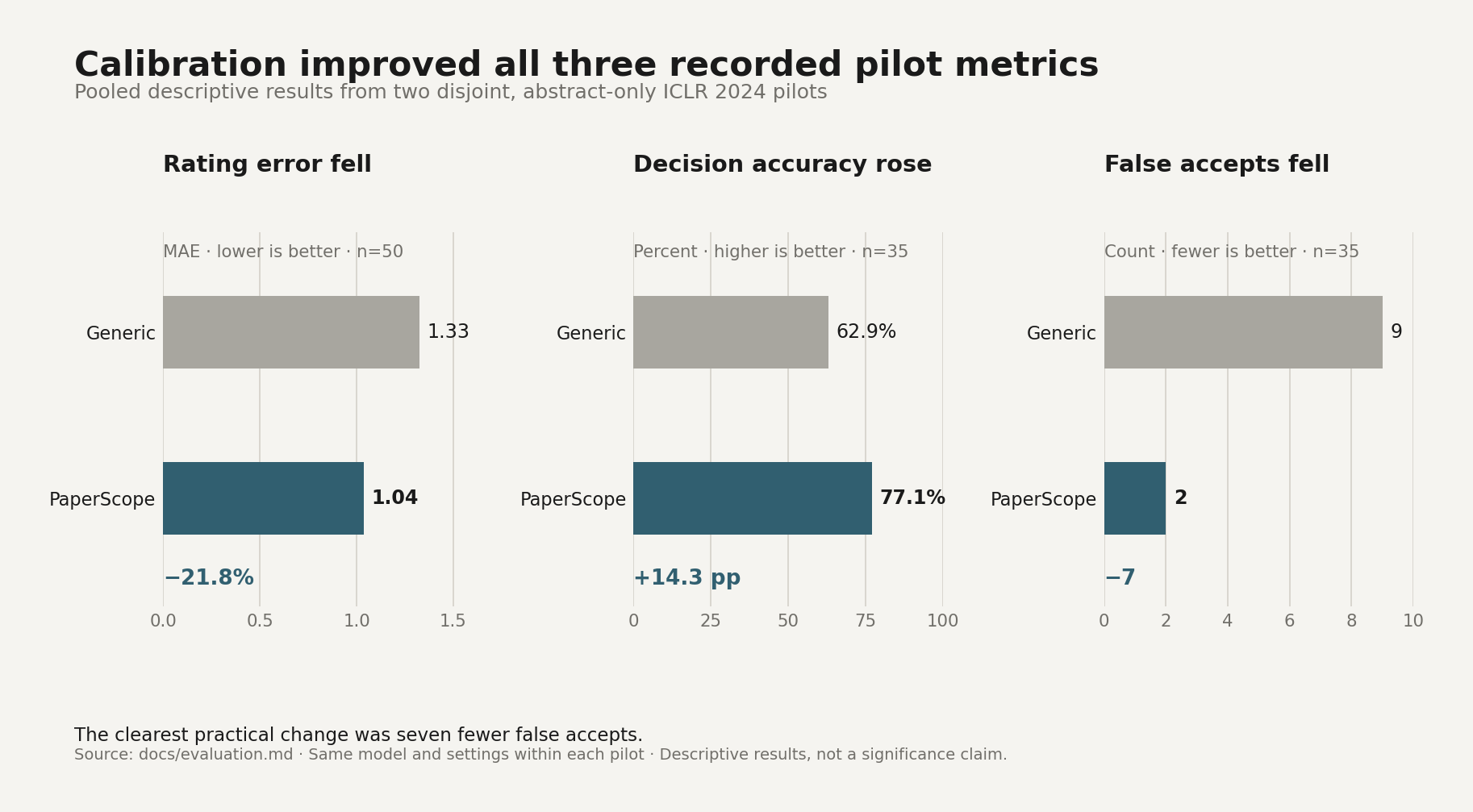
- rating MAE in the descriptive ICLR pilots
- −21.8%
- decision accuracy after calibration
- 62.9 → 77.1%
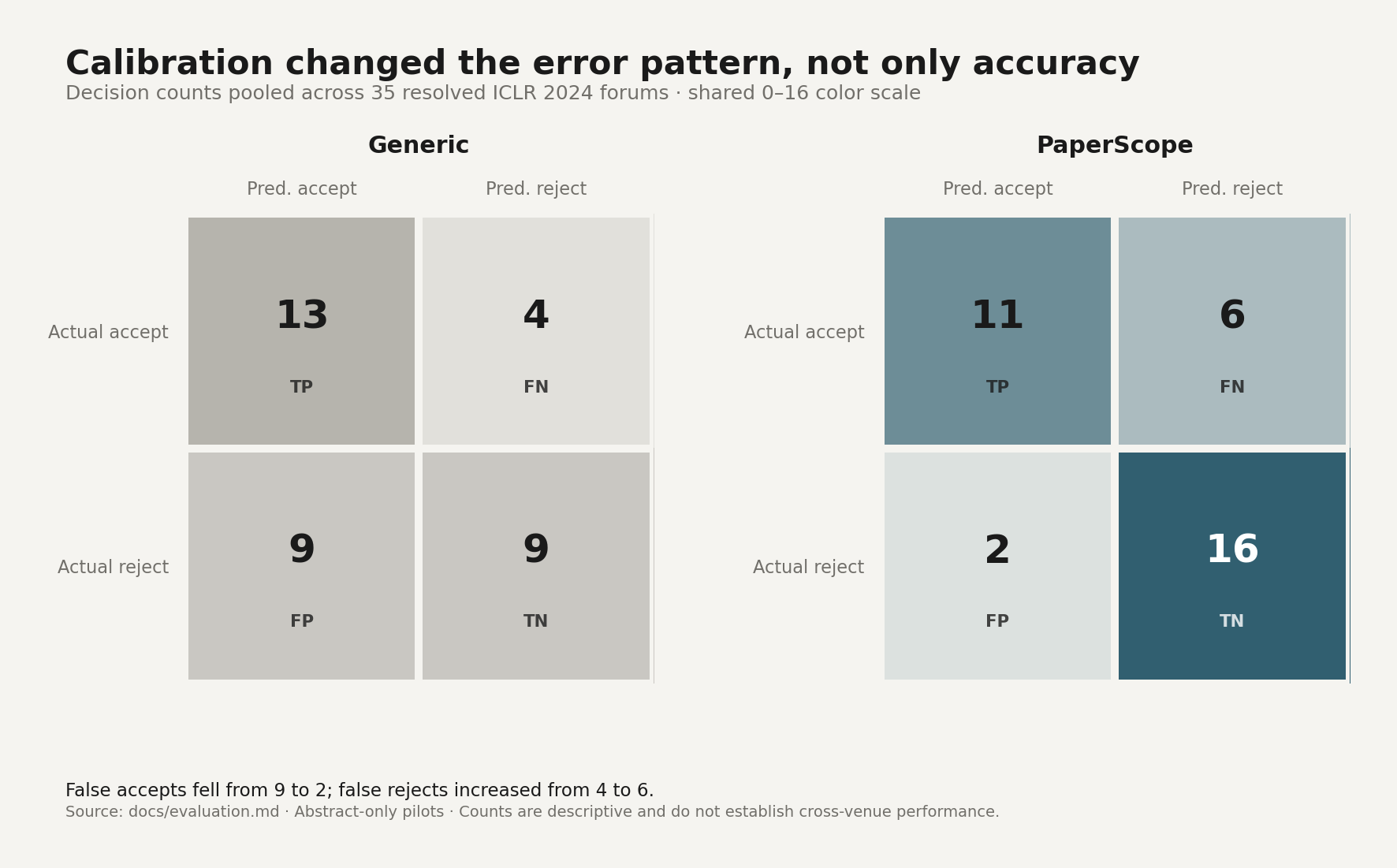
- false accepts in the recorded comparison
- 9 → 2
Result figures
What the work showed
- Venue calibration improved each of the three recorded descriptive metrics in the ICLR pilot runs.
- The largest practical change was fewer false accepts, suggesting the calibrated evaluator became more conservative in the tested setting.
- Leakage controls were essential because a strong score is meaningless if review outcomes can reach the model input.
What it does not prove
- The pilot results are descriptive and were not reported as statistically significant.
- The evidence is not yet cross-venue; behaviour on other conferences or fields may differ.
- The system estimates historical review behaviour. It does not define scientific quality or replace expert review.
Conclusion
Historical calibration made the evaluator more aligned with the tested venue, especially on false accepts. The result is promising, but the careful claim is narrow: it worked in these ICLR pilots and still needs broader validation.