In one line
SpikeLab turns continuous recordings and pre-sorted NeuroExplorer data into a traceable analysis workflow. Every stage can be inspected, rerun, and exported instead of being locked inside a proprietary interface.
Question
Can one local tool make multi-electrode array analysis reproducible—from raw spike detection to burst and waveform measurements—without hiding the important decisions?
What I built
- Built an offline Streamlit application for spike detection, waveform analysis, inter-spike intervals, firing rates, burst detection, and electrode comparison.
- Supported both continuous recordings and already sorted NeuroExplorer spike data so the same measurements can be checked across workflows.
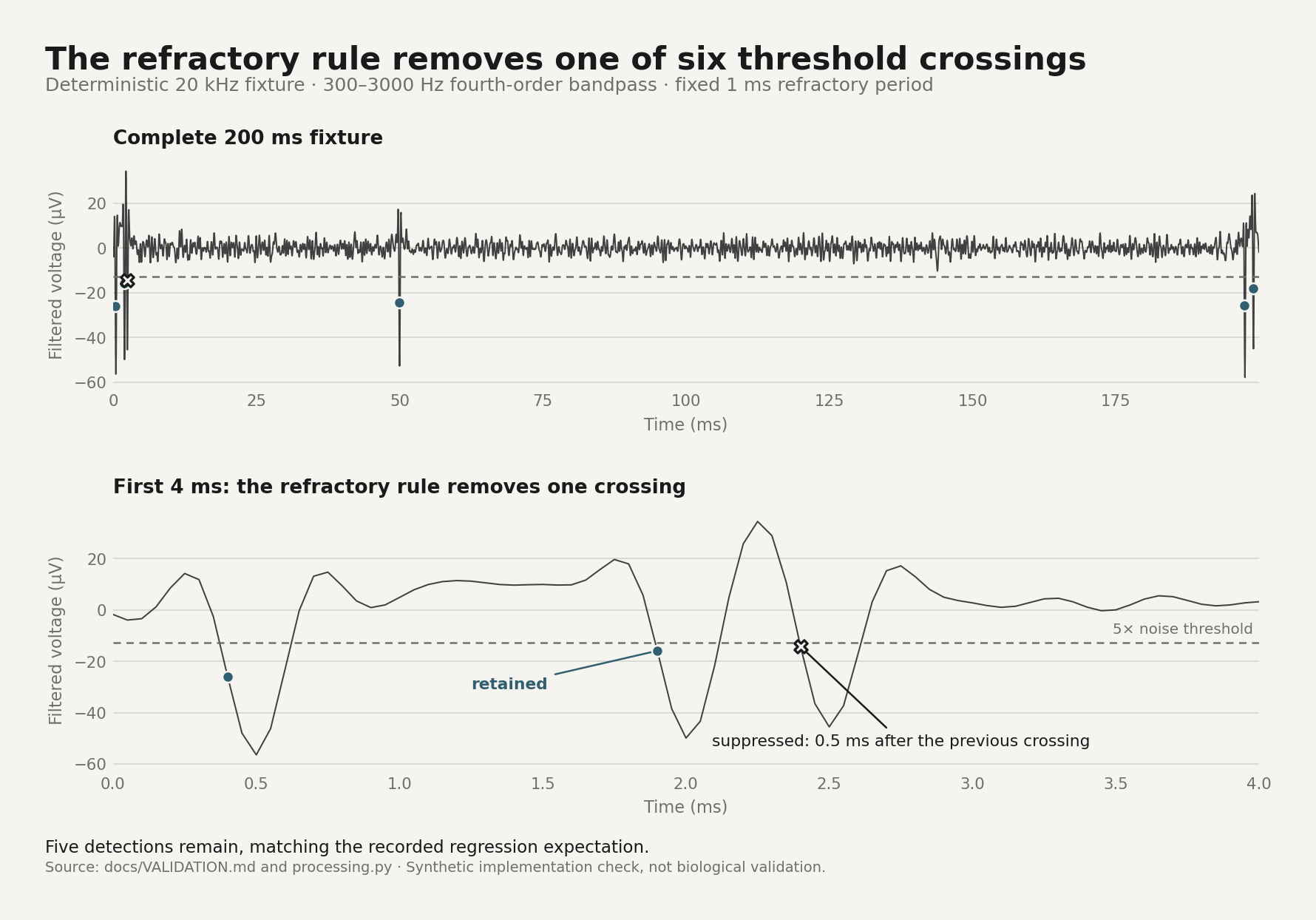
- Added reproducible exports and deterministic fixtures for burst algorithms, filtered detection, waveform boundaries, and EDF calibration.
Main result
- of tested NeuroExplorer results reproduced
- 95%
- analysis areas covered by regression fixtures
- 4
Result figure
What the work showed
- The tool reproduced the reference NeuroExplorer output in 95% of the cases recorded during the project.
- Fixed inputs now produce fixed expected outputs, making changes to detection and burst logic easier to audit.
- The workflow keeps raw traces, detected events, derived metrics, and exports connected, reducing manual hand-offs between tools.
What it does not prove
- The deterministic fixtures check software behaviour; they do not prove that an algorithm is biologically correct for every preparation.
- Detection thresholds and burst parameters still require experimental judgement and should be reported with any scientific result.
Conclusion
SpikeLab makes neural-signal analysis easier to inspect and reproduce. Its strongest contribution is not a new biological claim; it is a dependable path from a recording to results that can be checked.